
Reactance Quadrature
Theory
(a) Slip Test
- Check the phase sequence and voltage of the synchronous machine and the bus bar.
- Remove the field excitation and connect RYB terminals of machine to RYB of bus bar through a three phase variac.
- Start DC motor and adjust its speed near to synchronous speed, switch on the AC supply and apply a small voltage. The voltmeter connected across field winding should fluctuate and remains within the rated value, if the slip is small and direction of rotation is correct. The armature current should also fluctuate.
- Increase the AC voltage applied to the armature from the variac, such that maximum current is nearly equal to the rated full load current of the armature.
- Note down the maximum and minimum value of armature applied voltage and current.
- Calculate the applied voltage per phase (Vp = Vl / √3).
- Record the readings for different applied voltage.
(b) Maximum lagging current test for determination of Xq
- First run the synchronous machine as an alternator with the help of prime mover (dc machine) and synchronize it with bus bar.
- Switch off the DC supply to the motor so that the synchronous machine will run as a synchronous motor.
- Gradually reduce the excitation to zero.
- Reverse the field connection with the help of DPDT switch.
- Increase the excitation slowly in the negative direction till the machine shows sign of falling out of step. Note this field current, also note the line current.
Static test for determination of Sub-transient reactance
- With the rotor of the synchronous machine standstill apply single phase voltage from a variac across two phase winding connected in series. The field is short circuited through an ammeter.
- Rotate the rotor manually such that two positions of flux linking are apparent from the induced field current.
- Let the armature voltage and current corresponding to the minimum induced field current be Vq and Iq" and armature voltage and current corresponding to the maximum induced field current be Vd and Id".
- Record the readings for different applied voltages.
For Slip Test
- Zd = maximum phase voltage / minimum phase current
- Xd = √(Zd2 - Re2)
- Zq = minimum phase voltage / maximum phase current
- Xq = √(Zq2 - Re2)
- Re = Equivalent resistance / Phase of the alternator
Static Test for Xd" and Xq"
- Zd" = Vd / (2Id")
- Xd" = √(Zd"2 - Re2)
- Zq" = Vq / (2Id")
- Xq" = √(Zq"2 - Re2)
Equipments Required
| Equipment | Image |
|---|---|
| Fig.1: DC Motor - Synchronous Generator set | 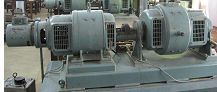 |
| Fig.2: Ammeter: 0 - 20A; 0 - 3 A | 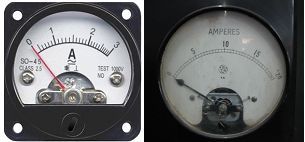 |
| Fig.3: Voltmeter: 0 – 30V; 0 – 250V | 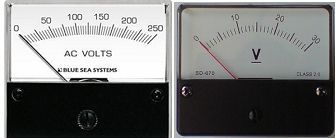 |
| Fig.4: Wattmeter: 0 - 1400 W |  |
Video for experiment:
To determine the direct axis reactance (Xd) and quadrature axis reactance (Xq) of synchronous machine.